

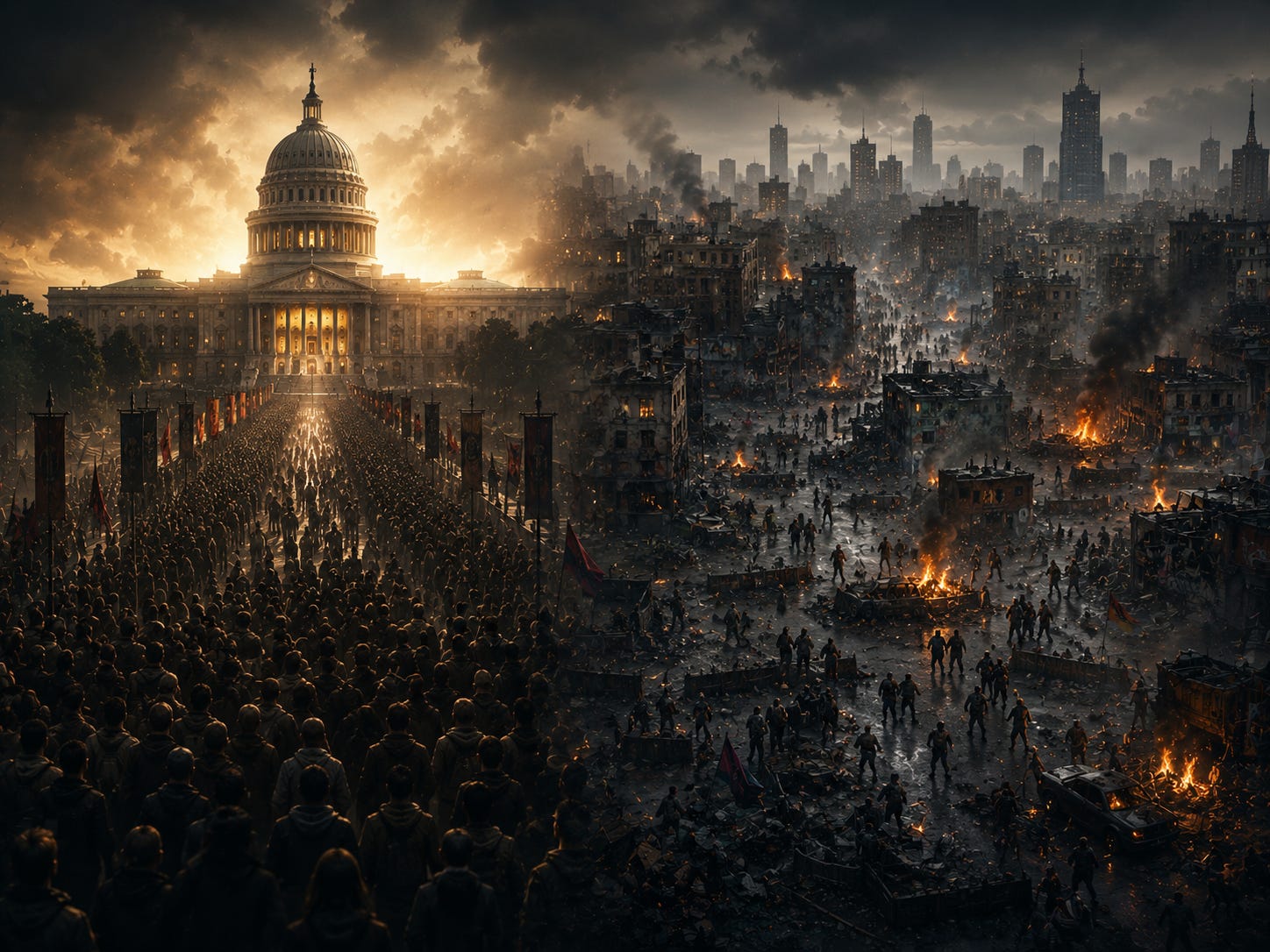
Revolution and civil war are not opposites.
They are different geometries of the same failure: legitimacy collapse.
A vertical revolution moves upward.
A horizontal civil war spreads outward.
The distinction is structural, not moral.
Vertical revolution requires a shared center of gravity.
Legitimacy concentrates upward, then snaps.
Pressure flows from many toward few.
Institutions, symbols, and command structures absorb the force.
Violence, when present, is directional and time-bounded.
Power is displaced, not diffused.
Horizontal civil war begins after the center dissolves.
No authority remains widely recognized.
Pressure has no vertical outlet.
Conflict redistributes laterally across populations, identities, and territories.
Violence becomes recursive. Retaliation replaces direction.
There is no terminal moment—only persistence.
Both conditions can use the same language.
Only one can use the same machinery.
Modern collapse is misclassified on entry.
Systems describe fragmentation as uprising.
Revolutionary language is applied after shared reality has already failed.
The label persists because it mobilizes.
The structure does not.
Media incentives favor spectacle over alignment.
Platforms amplify identity over institution.
Political actors externalize blame downward.
Security apparatuses prepare for unrest without restoring legitimacy.
Each actor behaves rationally.
The aggregate produces civil war dynamics without declaration.
In vertical revolution, power fears the crowd.
In horizontal civil war, neighbors fear each other.
Revolution requires shared reality.
Civil war consumes it.
When shared reality collapses first, vertical revolution becomes impossible.
Only its aesthetics remain.
Everyone claims to be overthrowing something.
No one agrees on what that thing is.
The machinery continues to run.
Horizontally.
