

They rarely start the story themselves.
When asked, the words come out uneven — fragments, detours, sudden silences. Memory doesn’t line up neatly after war. It leaks.
A tangent about wrestling.
A joke about politicians.
Then a stare through the wall.
The body returned home.
The war didn’t.
Public ritual solved the rest.
Parades.
Beer commercials.
Flag graphics on discount T-shirts.
Gratitude became theater — a national ceremony designed to convert violence into symbolism.
The uniform absorbs the story.
The person underneath disappears.
Some came home expecting flowers.
Instead they found locked doors, accusations, and a country already rewriting the war into something cleaner than what happened.
Others came back carrying images that dissolved the idea of meaning altogether.
Some learned the structure of the war in a different way.
A lieutenant arrives from an academy.
Confident. Loud. Certain the textbook applies.
By morning the platoon has made its own decision.
The bullet enters from behind.
No investigation follows.
Authority failed long before the shot.
One veteran explained the moment the war revealed itself.
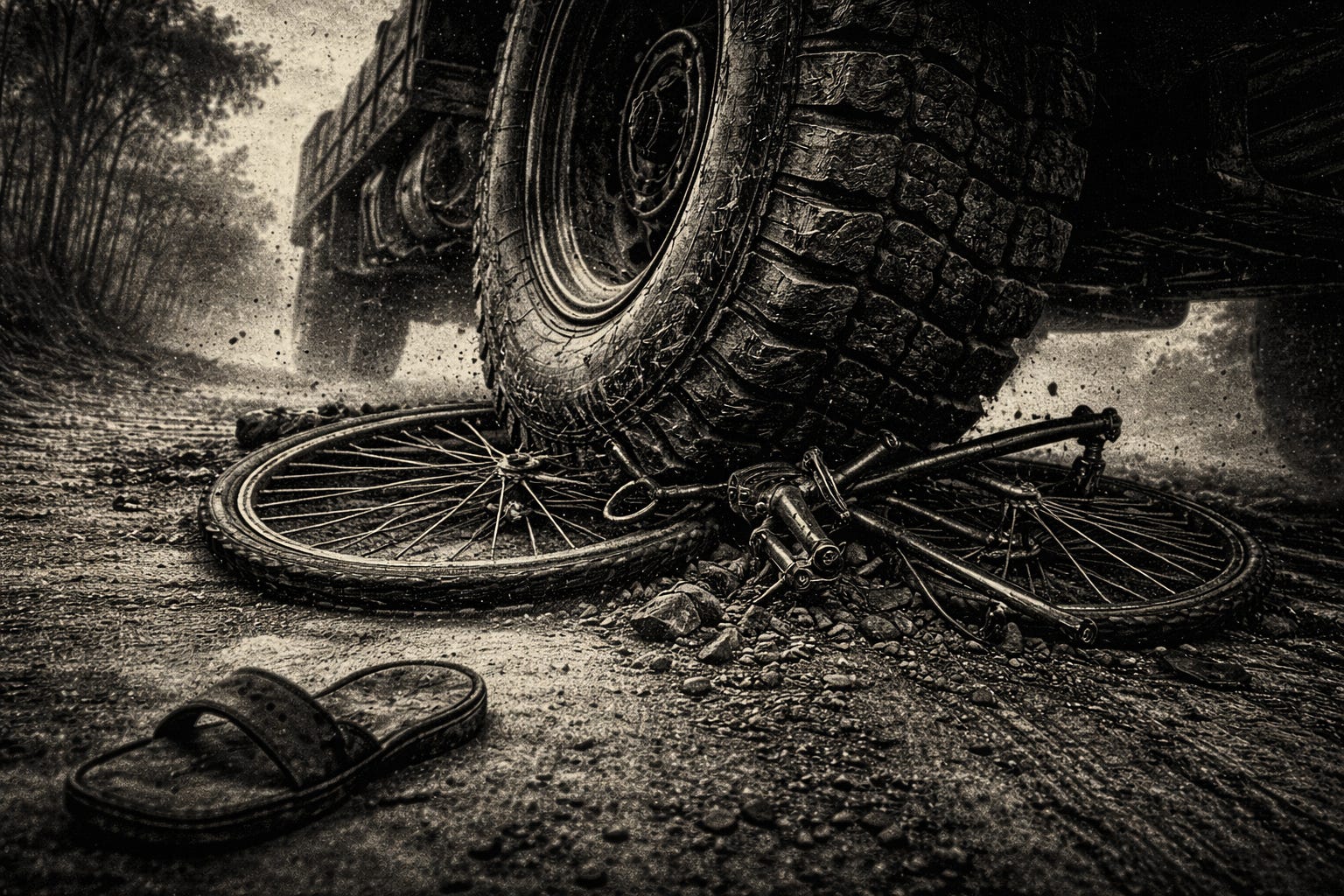
A transport rolled over two people on bicycles.
No one reacted.
The uniforms weren’t dirty yet.
Violence had already become routine.
That is the real architecture of modern war:
Every strike manufactures the next ambush.
Every escalation produces the enemy it claims to eliminate.
Empires call this strategy.
The ground calls it gravity.
Decades later the war still surfaces in quiet rooms.
A veteran pauses mid-sentence.
Forgets where the story ends.
Tries to remember if a friend survived.
The memory stalls.
Not grief.
System failure.
The country moved on.
The war did not.
Instead it was sealed inside the people who carried it home — a long-term storage system disguised as patriotism.
The uniform was buried.
The war was archived in human bodies.
And the archive is still open.
