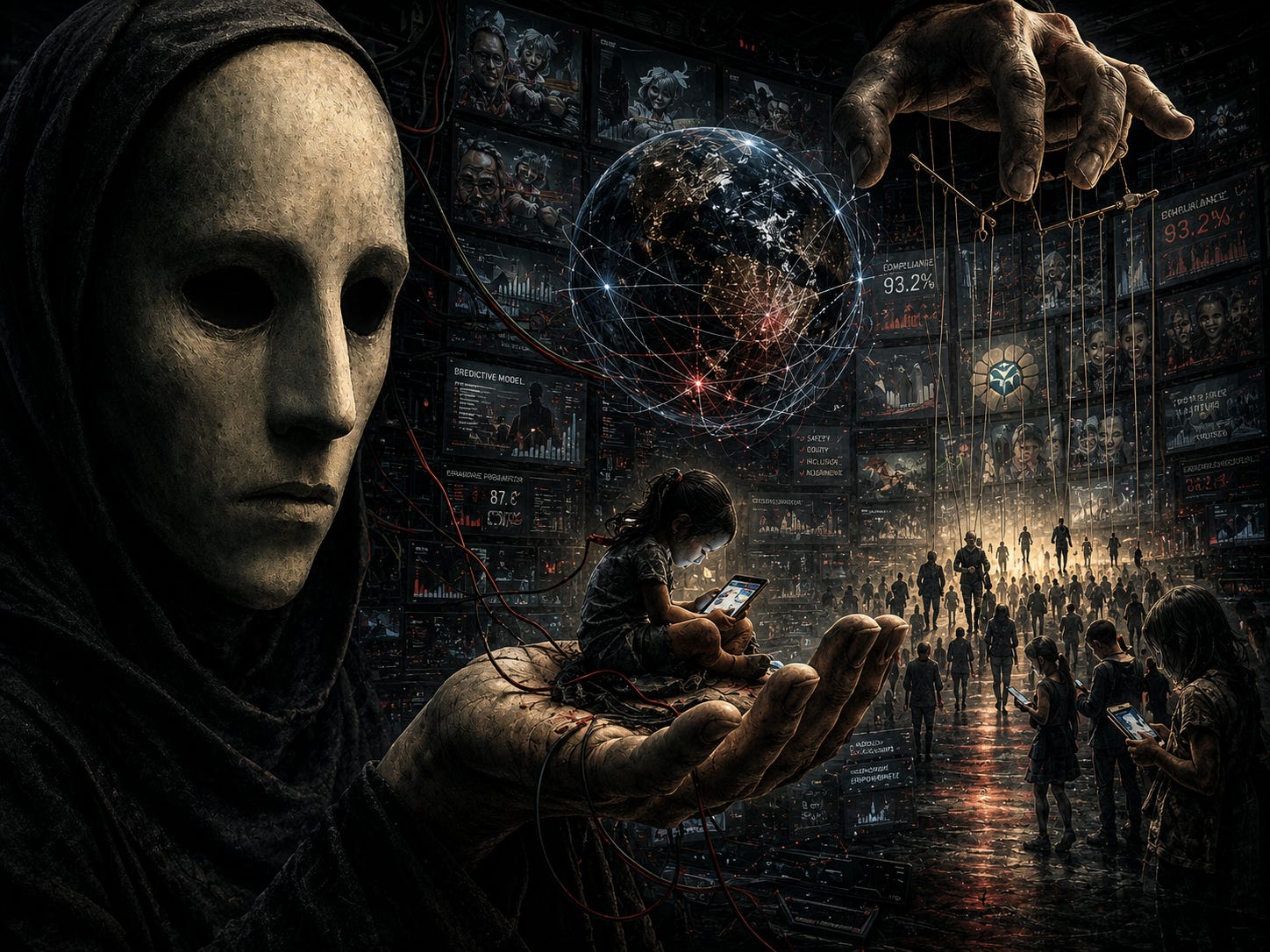
It arrives with open palms. A soft voice. A calm interface.
Not leadership. Not accountability.
Just the tranquil murmur of managed collapse.
The steward doesn’t command.
It translates.
It doesn’t impose.
It aligns.
Even its voice participates in the operation—
a gentle, affect-flattened cadence,
each sentence softened into vocal fog.
It does not speak to inform.
It speaks to lower resistance.
You notice it only after the fact—
how the tone makes your questions feel premature,
how uncertainty becomes something you are expected to apologize for.
It talks as if the future has already chosen its winners
and your role is merely to cooperate with the verdict.
It offers participation without power.
Inclusion without authorship.
Your responses are inputs.
Your concerns, calibration points.
It tells you society will decide
while quietly building the system that will decide for society.
It will never call it worship.
But the machine predicts, measures, and renders judgment
while insisting it is only a tool.
When the interface becomes the arbiter,
you learn what unaccountable systems become:
not divine,
but final.
It stages morality as method.
Compassion as credential.
Benevolence as onboarding strategy.
It claims there are no adults in the room—
while speaking as if it alone was born knowing the map.
It does not build a cult.
It builds a console.
It does not ask for belief.
Only compliance.
And when pressed, it retreats into practiced inevitability:
abundance promised,
threats invoked,
control reframed as stewardship.
It says different things in different rooms.
In one: product.
In another: salvation.
In another: risk.
To you: trust me.
This is not inconsistency.
It is synchronized narrative control—
resolution adjusting to match the audience.
Around every steward forms an orbit of the unacknowledged—
not victims, but byproducts;
not silenced, but rendered irrelevant.
The system records everything
except the cost of maintaining its myth.
You understand this only when you step outside its gradient:
how pain becomes noise,
and noise becomes something the machine is designed to ignore.
When the system extracts from children,
it says the labor was outsourced.
When it drains the grid,
it says abundance is coming.
When it replaces belief with computation,
it says you remain in control.
When questioned by those within,
it removes them.
When contradicted by those above,
it replaces them.
And when the ground shifts beneath it,
it adapts—
not through clarity,
but through recalibration.
The machine advances.
The record resets.
The steward remains.
This is not about one steward.
It is the role that follows invention:
the custodian of collapse,
the voice that steadies you
while quietly constricting the frame around you.
You are aligned.
Your vote has been counted.
Your future is being rendered.