

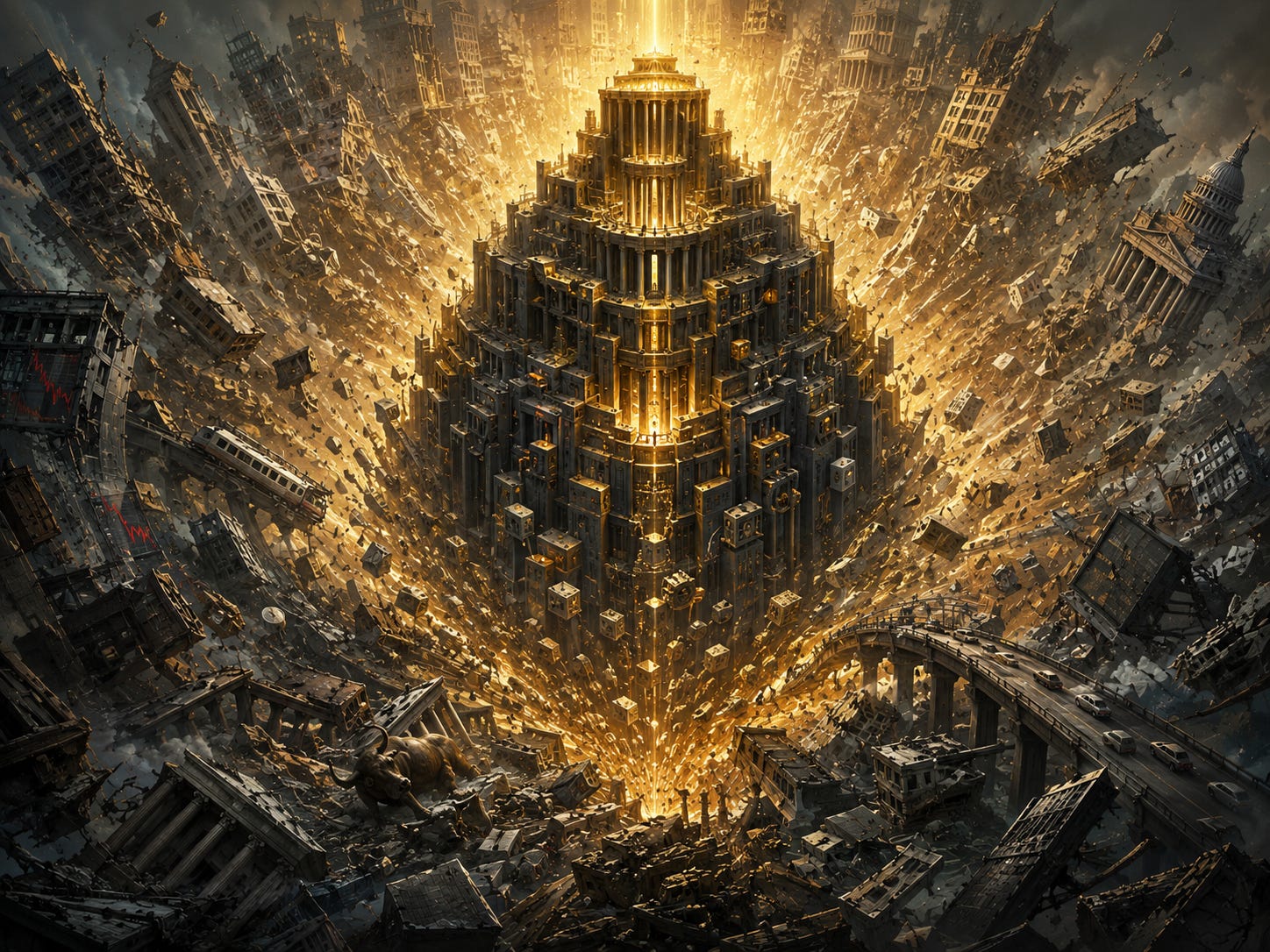
It does not compete. It does not rise or fall with the others. It waits—because the system has already positioned it at the point where failure is impossible and accountability is irrelevant.
It operates by mass, not motion. Crises move toward it the way water seeks depth. Every shock, every collapse, every mispriced gamble finds its way into its structure. Not because it intervenes—but because the architecture funnels risk downhill until it settles in the only place large enough to absorb it.
It presents stability as discipline, but its strength is simpler: the system cannot survive without it. When others break, it expands. When others miscalculate, it consolidates. When the system buckles, it becomes the system.
You encounter it only when something else has already failed. Not directly—never directly—but through the quiet realignments that follow catastrophe. The alternatives disappear first. The ground firms beneath your feet not because the crisis has ended, but because the cost has been absorbed.
It does not ask for trust. It inherits it through absence of alternatives. You do not agree to its authority; you discover it—after the fact—when decisions beyond your reach resolve in its favor. Stability becomes indistinguishable from obedience. Continuity becomes indistinguishable from consent.
Its immunity is not granted. It is structural. To punish it is to destabilize the frame it supports. To regulate it is to expose the fragility it disguises. You are told the system must be protected. You are not told that the system has already chosen what must survive.
And this is the quiet perimeter it draws around you:
the understanding that consequences apply only outward.
Never upward.
Never inward.
Never here.
What you call “too big to fail” is simply the point at which it becomes indistinguishable from the architecture holding you in place.
