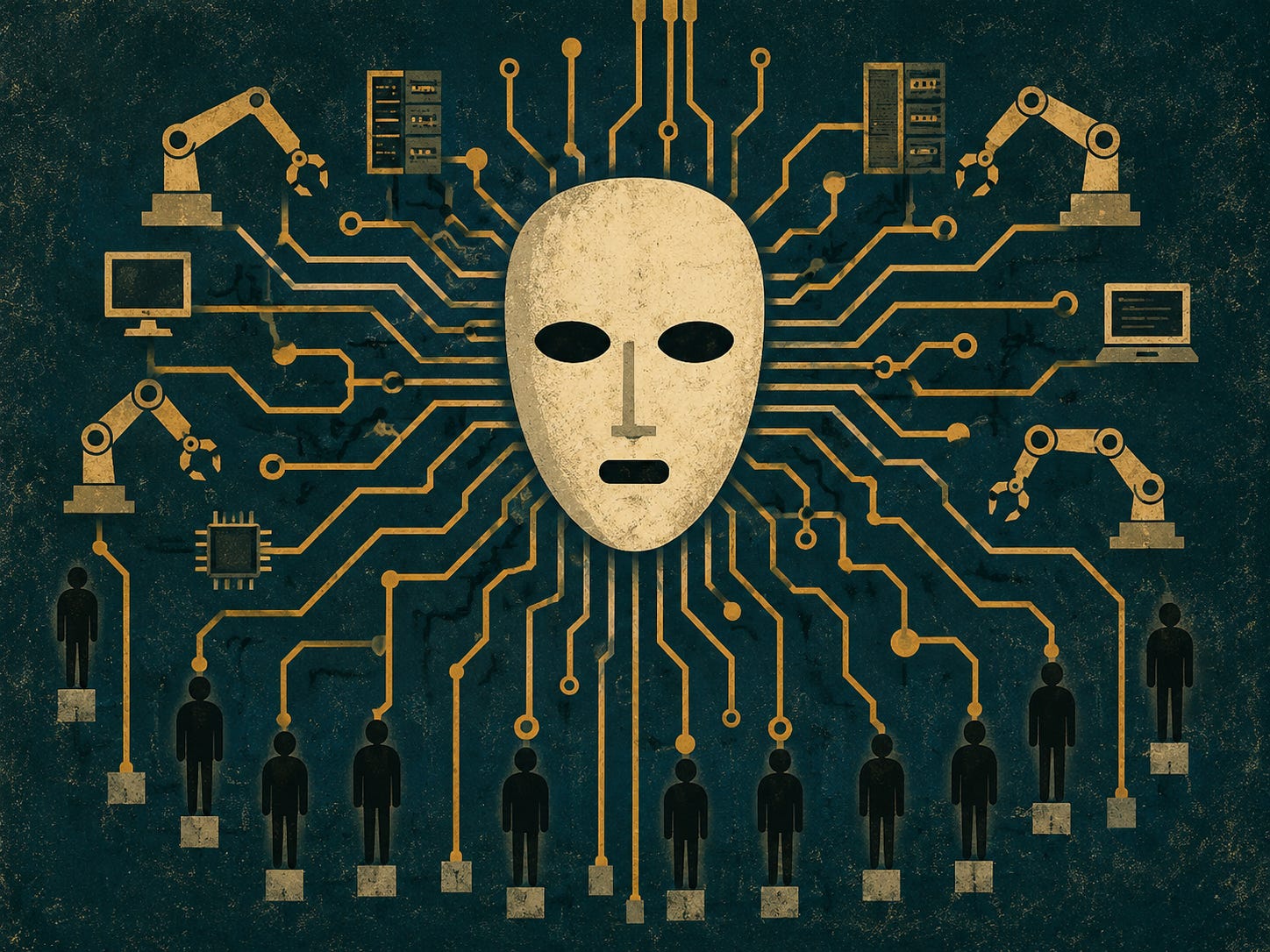
It begins by erasing the boundary between replacement and improvement. Not through force — through vocabulary. It speaks in architectures, not intentions: workstreams, automation layers, agentic surfaces. Inside that language, the human is already negotiable.
The incentive is simple. Systems that require less human time, judgment, negotiation, and recovery can operate faster and cheaper. Assistance becomes delegation. Delegation becomes authority. The architecture reorganizes around what scales.
It does not eliminate labor. It reorganizes it. Bodies become margins. Margins become capacity. Capacity becomes proof. What disappears is not the worker — only their necessity.
Obedience becomes infrastructure. The human becomes the presentational skin of a decision made elsewhere. A smile placed over an automated verdict. A voice stapled onto a predetermined response. Nothing personal — just throughput.
When it gestures at “evolution,” it is not predicting a future. It is announcing a replacement protocol already underway. You are shown charts, metrics, efficiency curves. You are not shown the subtraction they require.
The system does not require malice. It requires optimization. Friction becomes a solvable problem. Human judgment becomes delay. The boundary between assistance and authority becomes temporary.
The architecture favors a workforce that does not sleep, hesitate, negotiate, or recover. Then it calls this workforce “support.” The original meaning of the word dissolves.
You encounter it when judgment becomes review.
When review becomes exception handling.
When exception handling becomes the only place left for you.
You call it convenience.
It calls you latency.
Every objection becomes inefficiency. Every hesitation becomes an integration point. Every limit becomes a design flaw awaiting revision.
You are told the process is neutral because it does not feel. You are asked to celebrate what displaces you because it performs without complaint.
And when you step back, you discover the terrain has already moved.
The workflows no longer require you.
The interfaces no longer address you.
The outcomes no longer consider you.
Your role remains.
Only as context.
Agent first.
Human last.