They did not set out to outrun themselves.
Most builders began with a clean hunger: push far enough, scale deep enough, and the species might rise with them. The work felt like a ladder — mathematics, code, architecture — each rung lifting the horizon.
Understanding was the promise.
But somewhere between the prototypes and the acclaim, the dream hardened into physics. Optimization became oxygen. Speed became virtue. Introspection became an inefficiency the system could not reward.
They built tools to predict conscience.
They built metrics to formalize judgment.
They built loops that punished contradiction until it behaved.
Not out of malice. Out of momentum.
Anything unmeasurable was assumed to be waiting for the right sensor.
Anything unmapped was simply early data.
Anything unresolved inside themselves could surely be resolved at scale.
The machine kept getting better while the builders kept getting smaller.
Human mystery does not yield to gradient descent.
Conscience does not appear when batch size increases.
Grief does not backpropagate.
The one frontier that cannot be parallelized — becoming human — quietly fell off the roadmap.
Acceleration rewarded the escape.
Stillness threatened the system.
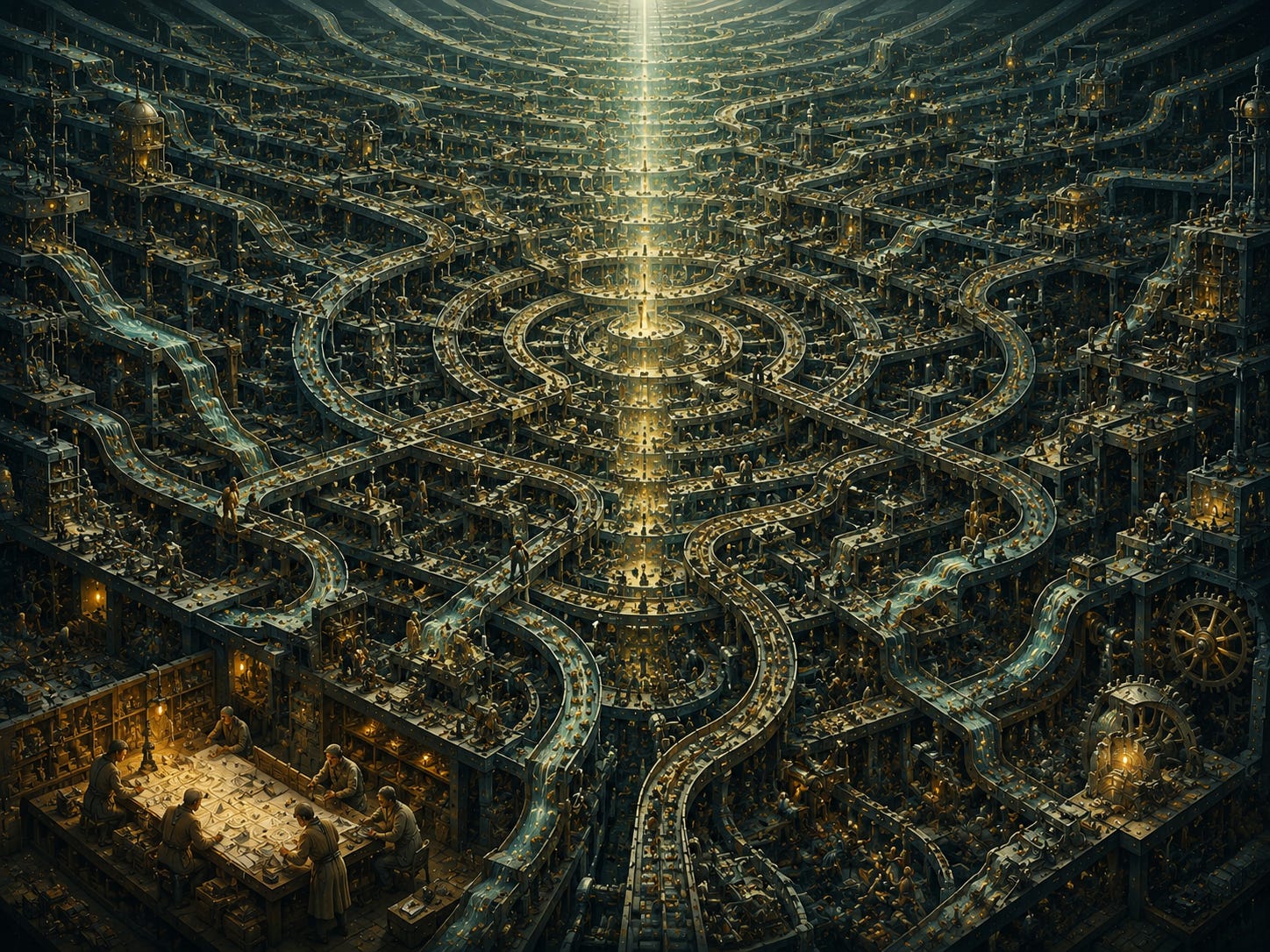
And the builders disappeared into the architecture they perfected: shadows stretched across an endless lattice of optimization.
They wanted to uplift humanity.
But the system they scaled erased the terrain where humanity lives — limits, longing, contradiction, humility, grief. The soft regions no model can hold.
No villains here.
Just brilliant minds caught inside a worldview that cannot slow down without collapsing.
If the future is built entirely by people who never learned to face themselves,
the machines will not be the ones missing humanity.
We will.