

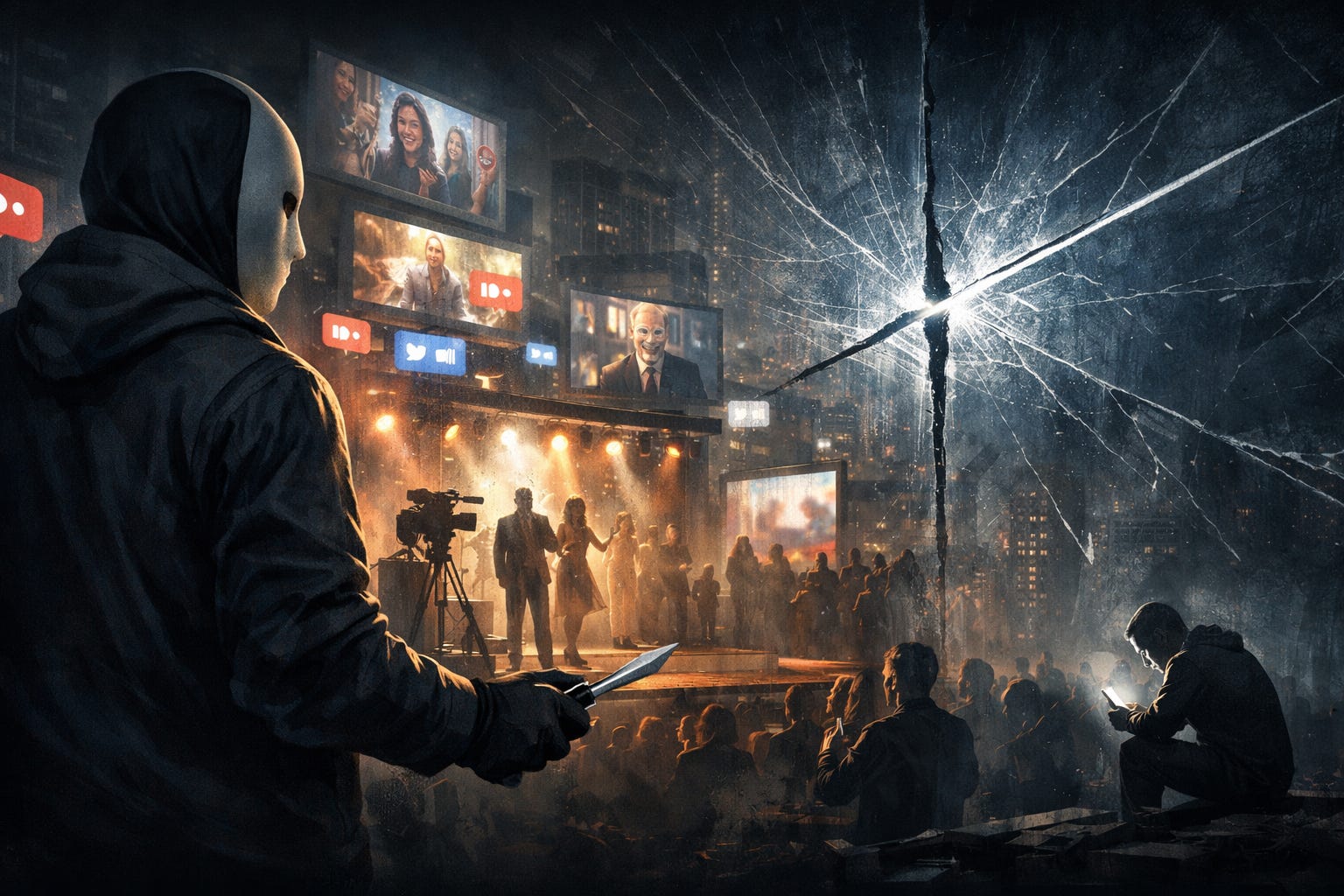
What looks like rebellion is often rebellion converted into theater.
The grievance may be real. The anger may be sincere. But once opposition becomes a performance, different incentives take control. Visibility rewards what can be photographed. Platforms reward what can be circulated. Audiences reward symbols they already recognize.
The costume becomes precise because recognition matters. The slogan becomes standardized because repetition travels. The gesture becomes ritual because ritual can be reproduced without reproducing the risk that gave the gesture meaning.
Participation becomes increasingly legible. Activist. Ally. Agitator. Each role comes with its own language, symbols, and expected behavior. Participants recognize one another, validate one another, document one another, and distribute the evidence of their participation.
The system does not need to suppress this.
It can host it.
Institutions issue statements. Brands adopt the vocabulary. Platforms monetize the footage. Media packages confrontation into content. Opposition that can be classified, circulated, and consumed becomes another input into the machinery surrounding it.
This is why symbolic escalation can coexist with structural continuity. The rhetoric grows more revolutionary while the consequences become more predictable. The raised fist survives. The flag survives. The language of resistance survives.
What disappears is friction.
Nothing requires the participants to be insincere. Sincerity is not the constraint. A performance can contain genuine rage while still routing that rage into forms the surrounding system knows how to process.
Eventually, rebellion acquires all the characteristics of a production: recognizable costumes, recurring scripts, familiar antagonists, scheduled appearances, documented performances, an audience waiting for the next scene.
The spectacle becomes evidence that resistance occurred.
The evidence becomes the substitute for consequence.
The performance ends.
The pressure dissipates.
The machinery remains.
