

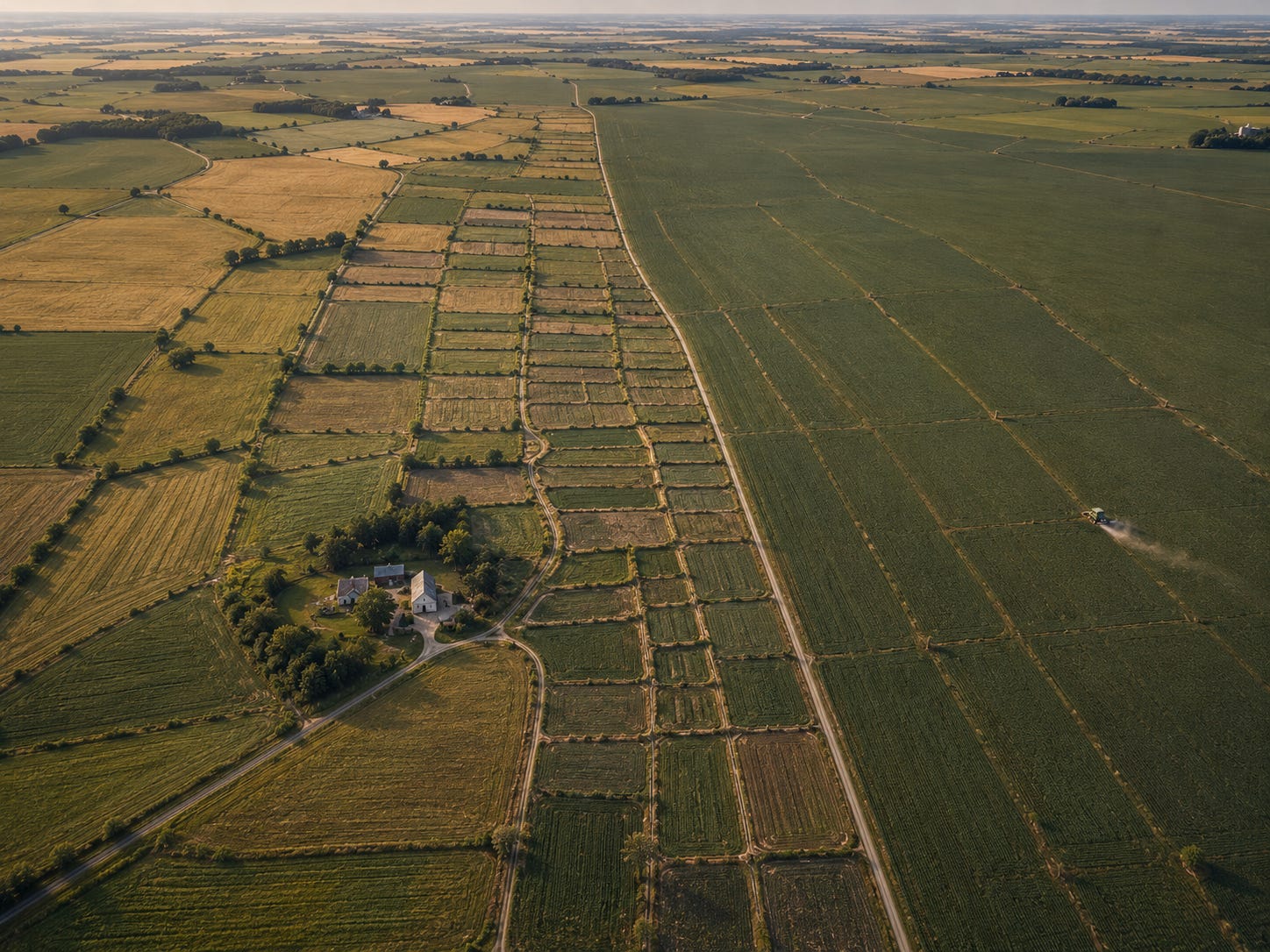
The farm was supposed to pass down.
Land moved from parent to child carrying more than a deed. It carried work already performed, debts already survived, buildings repaired, fences replaced, seasons remembered. Ownership accumulated history until acreage and family became difficult to separate.
Then inheritance changed the arithmetic.
One farm became several claims against the same ground.
One child stayed. Another left. A third built a life somewhere else. They inherited equal ownership without inheriting an equal relationship to what they owned.
To the one farming, the land remained productive infrastructure. Selling acreage could reduce the operation that generated the income required to keep farming.
To the others, the same acreage was inherited wealth. Keeping it intact meant leaving their share of the estate inside an asset they did not use.
Nobody had to become greedy. The deed had already created the conflict.
Appreciation tightened it. As farmland became more valuable, every heir’s claim became more valuable with it. But a higher appraisal did not necessarily give the farmer more cash with which to buy the others out.
The farm could become wealthier while becoming harder to keep.
Continuity now required someone to carry its cost. Debt could buy out an heir by placing a new obligation on the operation. Renting could preserve ownership by separating the family further from the work. Selling a parcel could protect the remainder by liquidating part of what inheritance was supposed to preserve.
Joint ownership could preserve everything except agreement.
Owners who wanted little from one another could still need signatures, distributions, valuations, and decisions from one another. Personal distance did not end economic proximity.
Families supplied their own stabilizers. A parent mediated. A sibling yielded. Someone accepted less, waited longer, or absorbed resentment because keeping the land intact was worth something to them.
The structure could appear stable because a person was carrying its instability.
Then people changed.
Marriage changed finances. Divorce changed them again. Death removed mediators and created heirs. Someone who once preferred income could later need liquidity.
The land did not need to change for the agreement around it to become unstable.
Every mechanism kept something intact by placing the cost somewhere else.
Beyond the property line, agriculture rewarded absorption. Machinery increased the acreage one operator could work. Fixed costs favored scale. Retiring owners could rent ground to operators positioned to carry more of it. Neighboring farms could expand without the neighboring family continuing to farm.
Consolidation did not require the family farm to disappear. It required the definition to survive.
A farm containing thousands of acres could remain a family farm. Inherited land rented to another operator could remain family-owned. Descendants who never worked the ground could remain farmland owners.
The phrase tracked lineage while the relationship between family, land, and labor changed underneath it.
Then another generation inherited.
More heirs appeared without more land appearing with them.
Ownership fractured into smaller claims against an asset whose market value could continue rising as its practical divisibility declined.
The farm could be partitioned, financed, rented, placed into an entity, partially sold, fully sold, or simply held together by people increasingly unwilling to remain tied to one another.
Sentiment remained in the structure.
It appeared as whatever someone was willing to carry to keep the land intact.
Eventually someone wanted liquidity. Someone wanted continuity. Someone had to carry the distance between them.
If the family could not, another structure could.
The neighboring operator could absorb the acreage. The investor could hold it. The developer could convert it. Another family could acquire enough scale to make its own succession problem larger.
The transaction resolved the claims without resolving the mechanism.
The money moved.
The land remained.
And somewhere inside another family, the deed began dividing again.
