Democracy with a Lock On

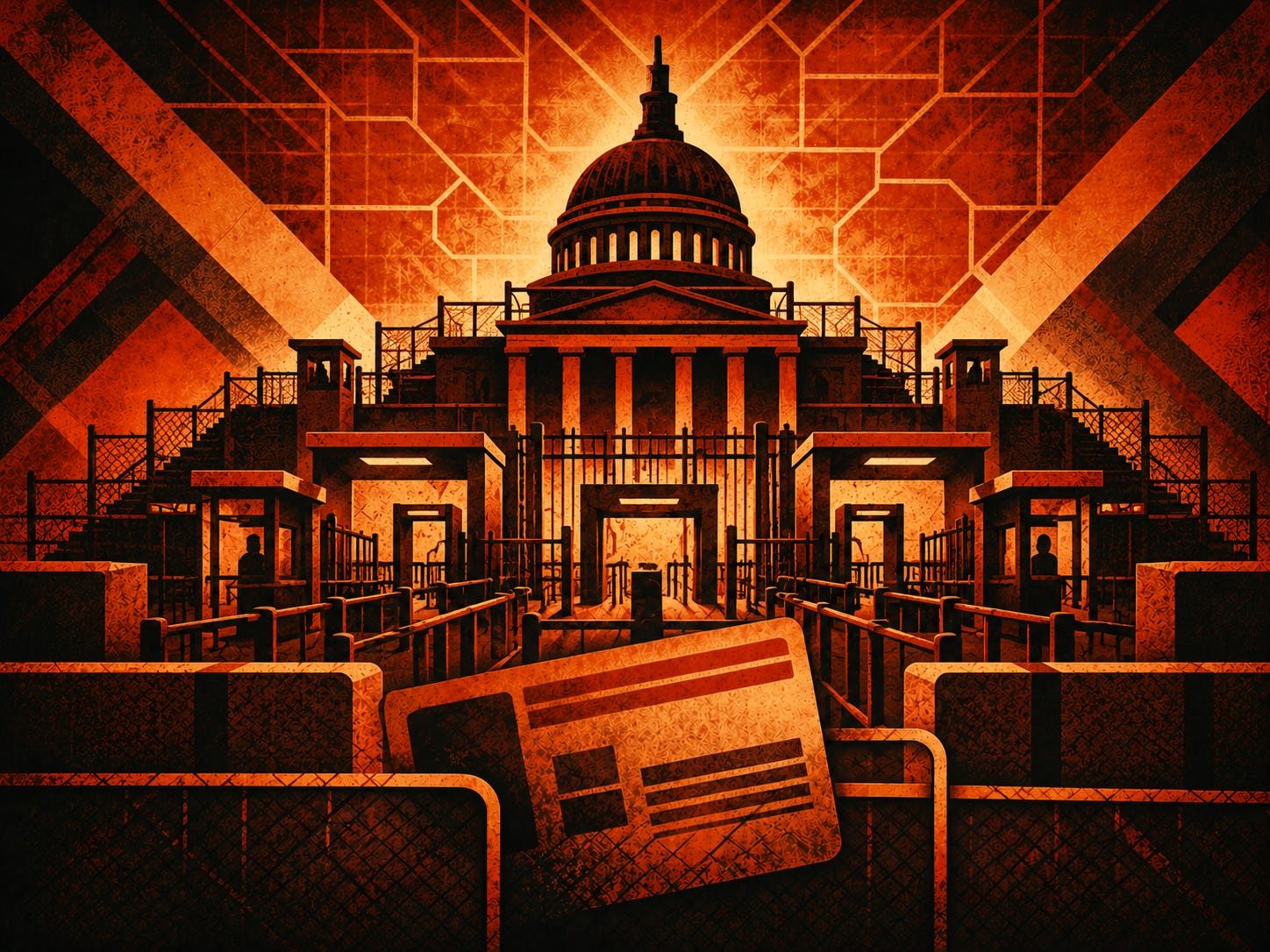
America stages the argument as paperwork.
Plastic cards. Identity verification. Common-sense safeguards.
The stated objective is electoral integrity. The neglected variable is participation.
Identification requirements are often defended through comparison with countries that maintain national identification systems and centralized voter registries. The comparison isolates the requirement from the infrastructure that makes compliance possible.
A document that is inexpensive, widely available, and routinely issued imposes a different burden from one that requires additional travel, supporting records, administrative appointments, or time away from work.
Infrastructure changes the cost of enforcement.
The United States administers elections through a fragmented network of state and local institutions. Registration procedures, identification requirements, documentation standards, and methods of verification vary by jurisdiction. The right to participate is national in principle, but the administrative cost of exercising it is not uniform.
That variation matters because elections are decided by those who participate, not by everyone entitled to participate.
Every procedural requirement creates a threshold. For some, compliance is nearly automatic. For others, it consumes time, money, transportation, or access to records. Even when the requirement is formally identical, the burden of satisfying it can be unequal.
The same threshold can be invisible to one voter and impassable to another.
The mechanism does not require universal exclusion. It operates through differences in friction.
Those differences become politically consequential wherever participation is unevenly distributed. Electoral coalitions are not composed of interchangeable voters. They differ in resources, geography, registration stability, and access to administrative systems. A requirement that imposes little cost on one population may impose substantially more on another.
The resulting burden does not need to change every election to matter. It needs only to alter the conditions under which participation occurs.
Political organizations already model electorates through turnout histories, demographic distributions, and geographic concentrations. They allocate resources according to who is likely to vote, where those voters live, and how reliably they can be mobilized.
Participation is therefore both a democratic right and an input into political strategy.
That creates a structural conflict.
The public legitimacy of an election depends on meaningful access to participation. The competitive interests of political actors depend on the composition of the electorate that actually participates. Measures that expand access can benefit one coalition while disadvantaging another. Restrictions can produce the opposite distribution.
Neither effect establishes the intent behind every rule. The incentive exists independently of whether it is acknowledged.
Electoral integrity is a legitimate administrative objective. Verification can serve it. But an integrity justification does not establish that every implementation is necessary, proportionate, or equally accessible.
The distinction disappears when the public debate treats the existence of a requirement as sufficient evidence of its legitimacy.
A rule can be facially neutral and operationally unequal. It can impose a real burden without producing a measurable national change in turnout. It can also serve a legitimate purpose while distributing its compliance costs unevenly.
These are separate questions. Political language often collapses them into one.
Identification becomes the visible object of dispute while the infrastructure determining access receives less scrutiny. Attention settles on whether a voter should possess a document, rather than on what the voter must surrender to obtain it.
Time. Money. Mobility. Administrative certainty.
The costs fall on individuals. The authority to define acceptable compliance remains with institutions.
That asymmetry is the machinery.
Political actors need not coordinate to benefit from it. Rules are proposed, defended, contested, and preserved within an environment where their consequences can be politically advantageous. An institution can maintain a barrier without declaring exclusion as its purpose. A coalition can benefit from unequal friction without proving that every individual supporting the rule intended that result.
The architecture can persist through ordinary incentives rather than a unified design.
And because its procedures are expressed in the language of administration, their political consequences can be discussed as though they were incidental to democracy rather than part of the conditions under which democracy operates.
The debate remains about identification.
The structure determines who bears the cost of being identified.
The lock is not on the ballot.
It is on the conditions of reaching it.

Discussion about this post