

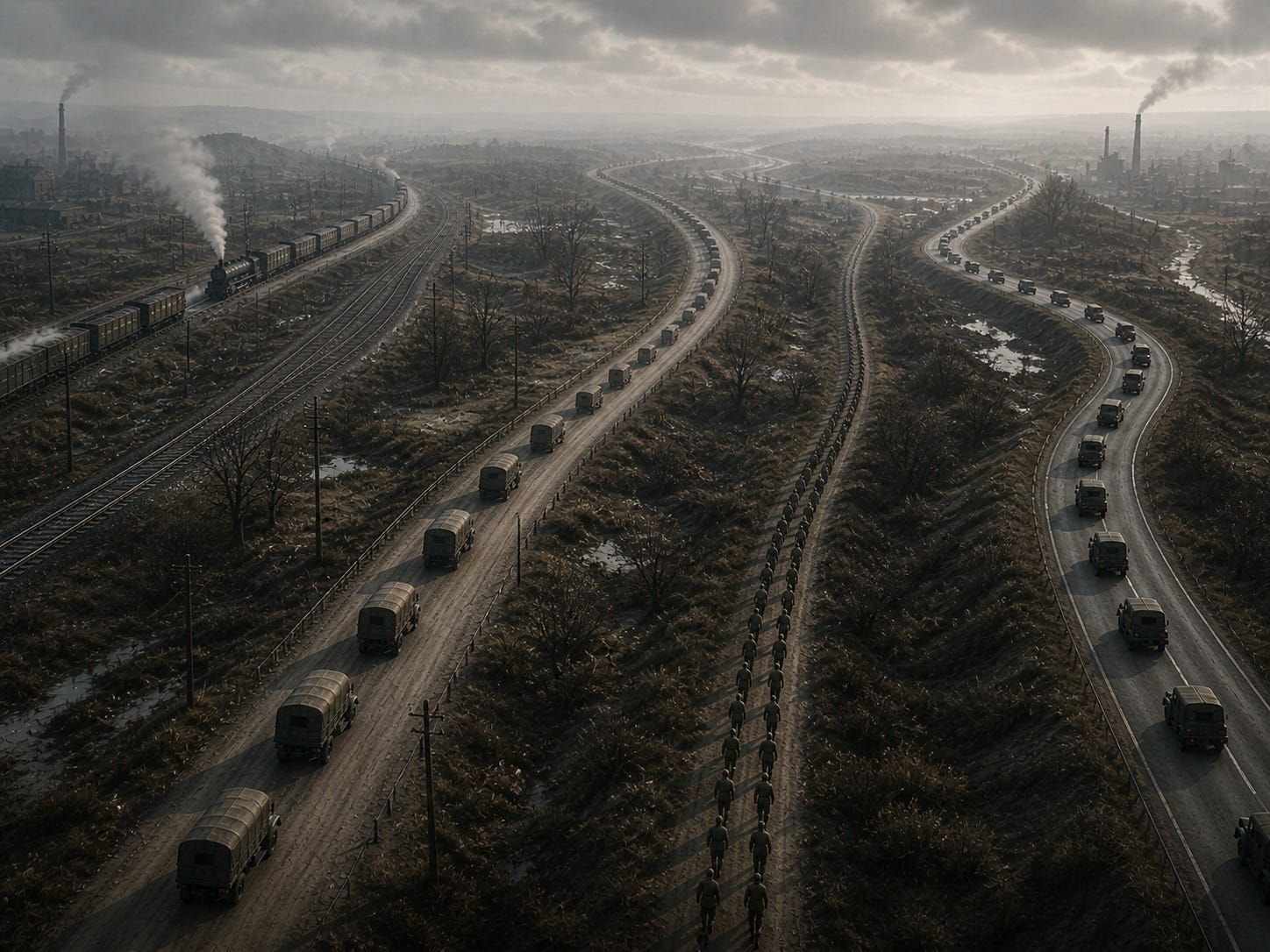
It did not begin as belief.
It began as architecture.
The war revealed that story could be used as a control system — a way to coordinate millions with the precision of machinery. Narrative stopped describing reality and started replacing it. What populations called destiny, leaders treated as throughput. What armies called purpose, systems used as input.
Myth proved itself faster than fact.
It mobilized bodies where logistics failed and converted failure into fuel. Catastrophe became continuation. Obedience felt inevitable.
Every front demonstrated the same mechanism. Purity functioned as a border protocol. Threat operated as directive. Identity mapped cleanly onto the territory it was required to secure.
Reality broke; the story did not.
Loss became proof of necessity. Encirclement became evidence of resolve. Death stabilized the system it could not disrupt.
Myth absorbed contradiction and returned coherence.
When the machinery scaled, it no longer required victory. It required only survival — and it survived everything. Cities burned, continents split, populations starved, and the narrative frameworks remained intact. Once a story endures that level of pressure, it becomes structural.
The conflict ended.
The operating system continued.
Postwar borders were drawn along narrative lines. Governments derived legitimacy from inherited scripts. Security doctrines were authored by the same myths that had once justified annihilation. The language of peace was built from the debris of mobilization.
Nothing about the aftermath contradicted the architecture revealed by the war. Myth had demonstrated it could reorganize the world more efficiently than reason, and the systems that emerged treated that demonstration as instruction.
You do not remember the installation.
You are running it.
